|
Inseop Chung I'm a Staff Researcher at the AI Center of Samsung Electronics, where I work on various topics in computer vision and machine learning. I received my PhD from Graduate School of Convergence Science and Technology (GSCST), Department of Intelligence and Information of Seoul National University (SNU) under the supervision of professor Nojun Kwak. I was a member of the Machine Intelligence and Pattern Analysis Lab (MIPAL) led by Prof. Kwak. My research focuses on domain adaptation, domain generalization, test-time adaptation, object detection, semantic segmentation, knowledge distillation, and vision-language-action models. Email / CV / Google Scholar / LinkedIn / GitHub |

|
Research InterestsI am a Staff Researcher at the AI Center of Samsung Electronics, specializing in computer vision, deep learning, and machine learning. My primary focus is on Vision-Language-Action (VLA) models for embodied AI and robotics, with the goal of building AI systems that can robustly perceive, reason, and act in complex, real-world environments. I received my Ph.D. from Seoul National University, Graduate School of Convergence Science and Technology, under the supervision of Prof. Nojun Kwak, and was affiliated with the Machine Intelligence and Pattern Analysis Lab (MIPAL). My past and ongoing research spans domain adaptation, domain generalization, continual/test-time adaptation, knowledge distillation, object detection, and semantic segmentation. Recently, I have been particularly interested in developing methods to make AI models more adaptive and generalizable to unseen scenarios. Currently, my main research direction is advancing scalable and generalizable VLA models that integrate vision, language, and action generation for robotic control. I have hands-on experience with leading frameworks such as OpenVLA and Physical Intelligence (π0). Furthermore, I also have experience with using NVIDIA Isaac GR00T N1.5 for control and Cosmos for world modeling, integrating them to enhance robotic manipulation and decision-making capabilities. My long-term vision is to enable embodied agents that can learn continuously from diverse environments, follow natural language instructions, and perform complex physical tasks with minimal supervision. |
News
|
Publications |
|
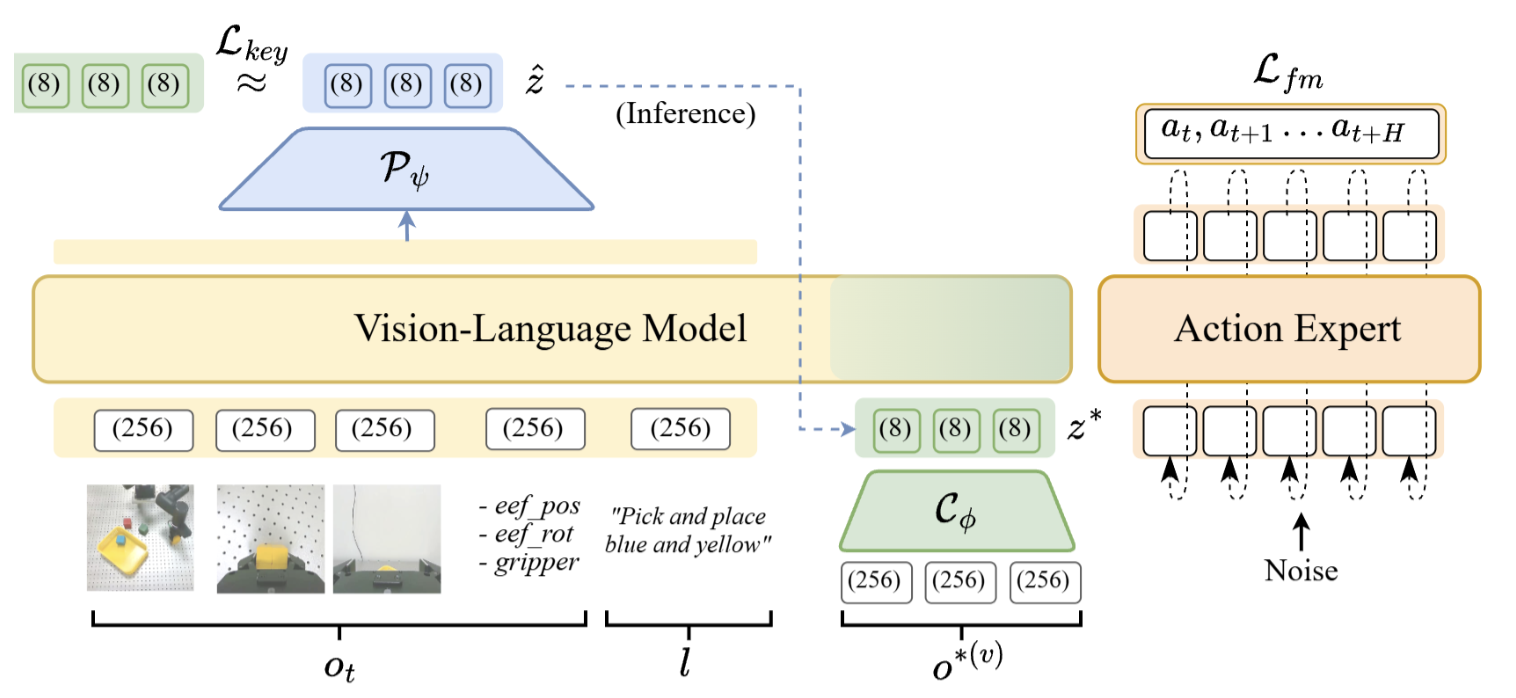
KAPPA(κ): Keyframe-Anchored Predictive Policy for
Vision-Language-Action
Jiwon Lee*, Inseop Chung*, Sujin Jang†, Jun Won Choi† Preprint KAPPA predicts a latent representation of the next keyframe as a future visual milestone and conditions each action chunk on this prediction, anchoring continuous control to a sparse sequence of task-critical milestones. It achieves 98.4% overall success (96.9% on long-horizon tasks) on LIBERO and 57.3% on RoboCasa atomic tasks, with real-robot gains of +5.0% and +17.5% for in-distribution and out-of-distribution settings, respectively. |
|
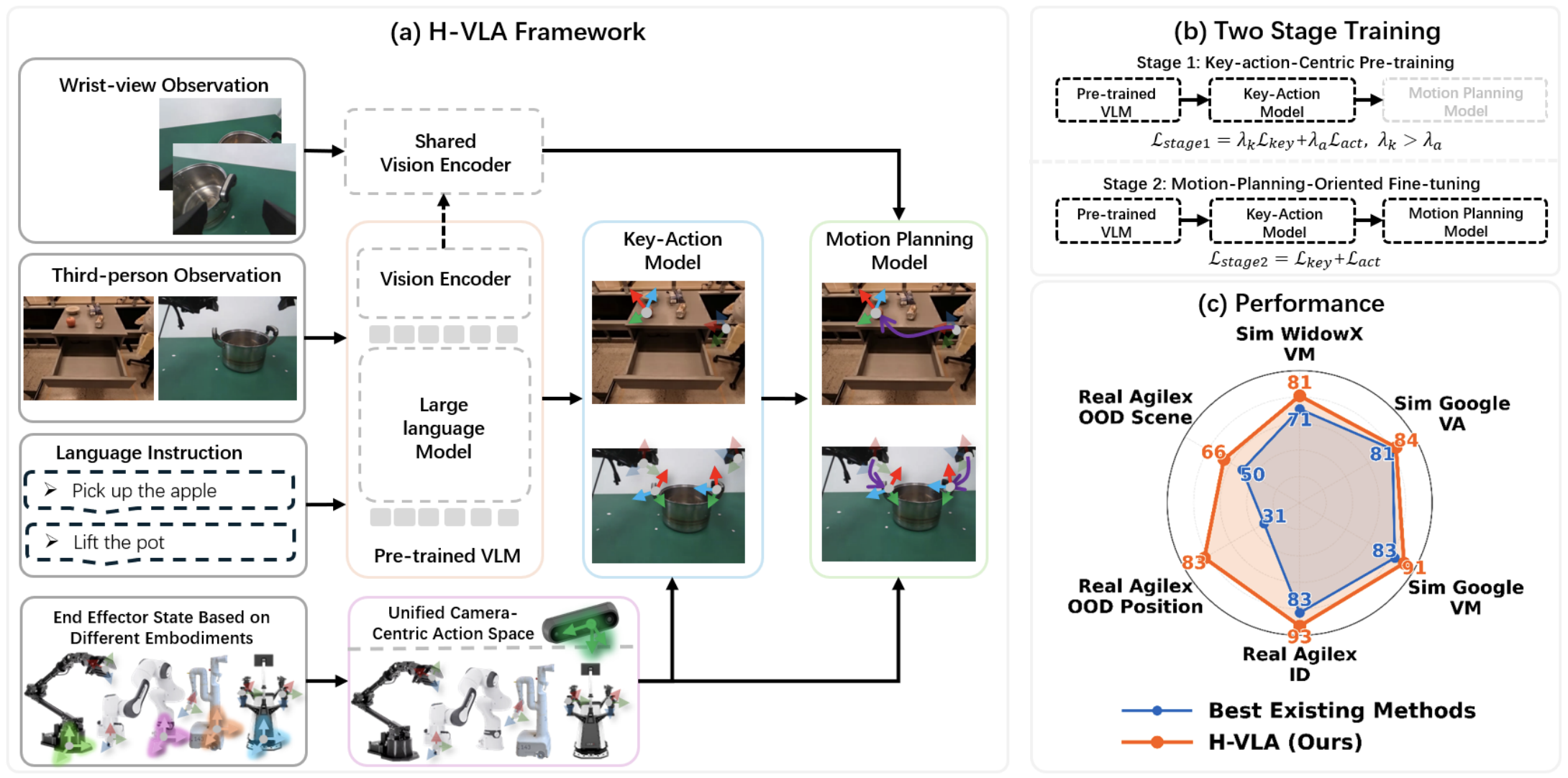
H-VLA: Hierarchical Vision-Language-Action Model with Key-Action
Reasoning and Motion Planning in a Unified Action Space
Xiongfeng Peng, Lu Xu, Yandong Wang, Jiaqian Yu, Zirui Zheng, Yamin Mao, Weiming Li, Inseop Chung, Hyun-woong Cho, Jaewook Yoo, Dongwook Lee, Daehyun Ji, Chao Zhang Conference on Robot Learning (CoRL), 2026.Nov arXiv Decouples key-action reasoning from motion generation via a unified camera-centric action space, giving consistent representations across embodiments and viewpoints. Achieves 91% on SimplerEnv Google Robot and up to +52 points on Agilex real-robot OOD tasks. |
|
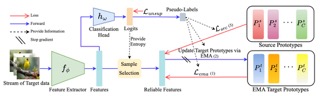
Mitigating the Bias in the Model for Continual Test-Time Adaptation
Inseop Chung, Kyomin Hwang, Jayeon Yoo, Nojun Kwak IEEE Access, 2025.Aug arXiv This work improves Continual Test-Time Adaptation by introducing class-wise feature clustering and source-aligned prototype anchoring. It dynamically reduces prediction bias and enhances model robustness under distribution shifts. |
|
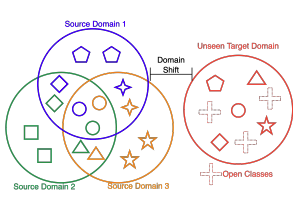
Open Domain Generalization with a Single Network by Regularization
Exploiting Pretrained Features
Inseop Chung, Kiyoon Yoo, Nojun Kwak ICLR 2024 Workshop, 2024.May arXiv We propose a single-network method for Open Domain Generalization that improves unseen domain generalization and unknown class detection. It leverages a linear-probed head and two regularization terms to refine the classifier while preserving pre-trained features, enabling efficient and robust generalization. |
|
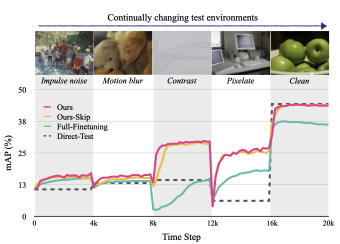
What, How, and When Should Object Detectors Update in Continually Changing
Test Domains?
Jayeon Yoo, Dongkwan Lee, Inseop Chung, Donghyun Kim, Nojun Kwak CVPR, 2024.Jun arXiv We propose a lightweight, architecture-agnostic test-time adaptation method for object detection under continual domain shifts. By updating only small adaptor modules and introducing a class-wise feature alignment strategy, our approach achieves efficient, robust adaptation without modifying the backbone, improving mAP on standard benchmarks while preserving real-time performance. |
|
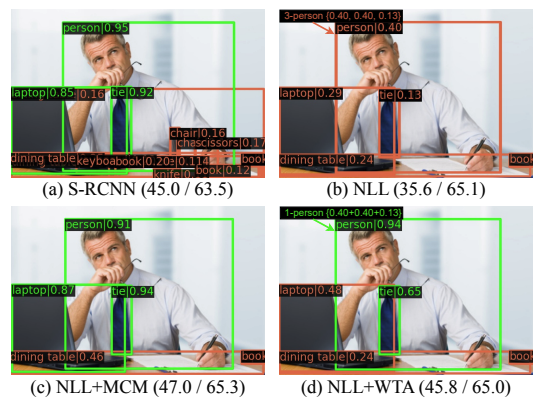
End-to-End Multi-Object Detection with a Regularized Mixture Model
Jaeyoung Yoo*, Hojun Lee*, Seunghyeon Seo, Inseop Chung, Nojun Kwak ICML, 2023.Jul arXiv We introduce D-RMM, an end-to-end multi-object detector trained with negative log-likelihood and a novel regularization loss. By modeling detection as density estimation, our method removes training heuristics, improves confidence reliability, and outperforms prior end-to-end detectors on MS COCO. |
|
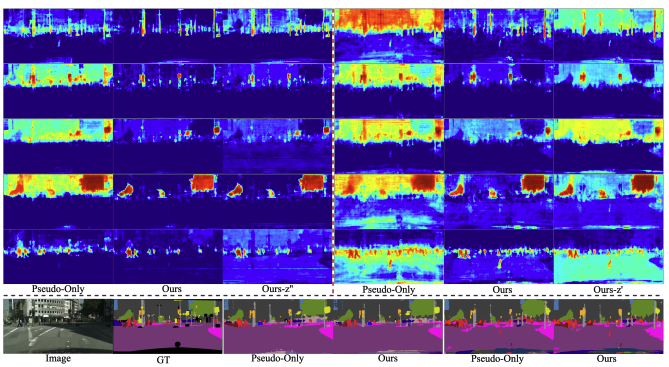
Exploiting Inter-pixel Correlations in Unsupervised Domain Adaptation for
Semantic Segmentation
Inseop Chung, Jayeon Yoo, Nojun Kwak WACV 2023 Workshop (Best Paper Award), 2023.Jan arXiv We enhance UDA for semantic segmentation by transferring inter-pixel correlations from the source to the target domain using a self-attention module. Trained only on the source, this module guides the segmentation network on the target domain beyond noisy pseudo labels, improving performance on standard benchmarks. |
|
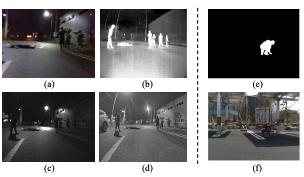
X-MAS: Extremely Large-Scale Multi-Modal Sensor Dataset for Outdoor
Surveillance in Real Environments
DongKi Noh, Chang Ki Sung, Taeyoung Uhm, Wooju Lee, Hyungtae Lim, Jaeseok Choi, Kyuewang Lee, Dasol Hong, Daeho Um, Inseop Chung, Hochul Shin, Min-Jung Kim, Hyoung-Rock Kim, Seung-Min Baek, Hyun Myung IEEE Robotics and Automation Letters (RA-L), 2023.Jan We introduce X-MAS, a large-scale multi-modal dataset for outdoor surveillance with 500K+ annotated image pairs across five sensor types. |
|
Unsupervised Domain Adaptation for One-Stage Object Detector Using Offsets
to the Bounding Box
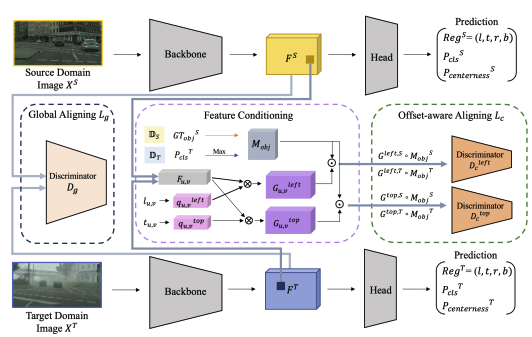
Jayeon Yoo, Inseop Chung, Nojun Kwak ECCV, 2022.Oct arXiv We propose OADA, an offset-aware domain adaptive object detector that conditions feature alignment on bounding box offsets to reduce negative transfer. This simple yet effective method improves both discriminability and transferability, achieving state-of-the-art results in domain adaptive detection. |
|
Dummy Prototypical Networks for Few-Shot Open-Set Keyword Spotting
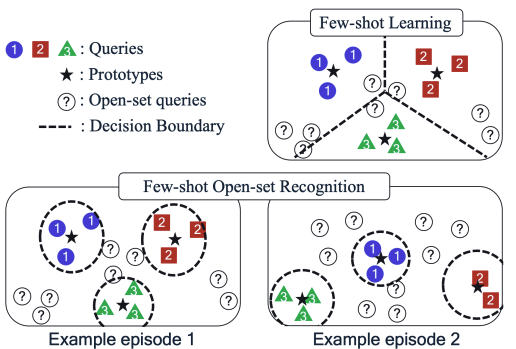
Byeonggeun Kim, Seunghan Yang, Inseop Chung, Simyung Chang INTERSPEECH, 2022.Sep arXiv We propose D-ProtoNets, a metric learning-based method for few-shot open-set keyword spotting. Using dummy prototypes, our approach effectively rejects unknown classes and outperforms recent FSOSR methods on both splitGSC and miniImageNet benchmarks. |
|
Personalized Keyword Spotting through Multi-task Learning
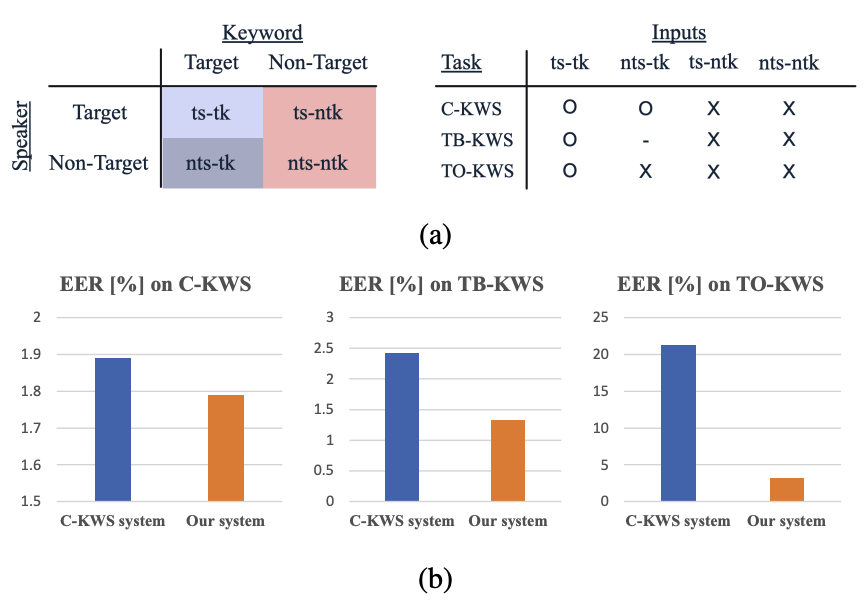
Seunghan Yang, Byeonggeun Kim, Inseop Chung, Simyung Chang INTERSPEECH, 2022.Sep arXiv We propose PK-MTL, a multi-task learning framework for personalized keyword spotting that jointly learns keyword spotting and speaker verification. |
|
Maximizing Cosine Similarity Between Spatial Features for Unsupervised
Domain Adaptation in Semantic Segmentation
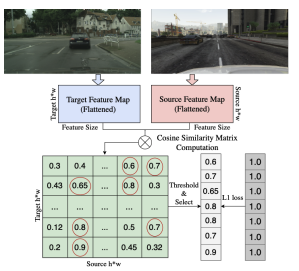
Inseop Chung, Daesik Kim, Nojun Kwak WACV, 2022.Jan arXiv We present a cosine similarity-based method for unsupervised domain adaptation in semantic segmentation. By aligning source and target features via a class-wise feature dictionary and similarity maximization, our approach reduces domain gaps and improves performance on standard UDA benchmarks. |
|
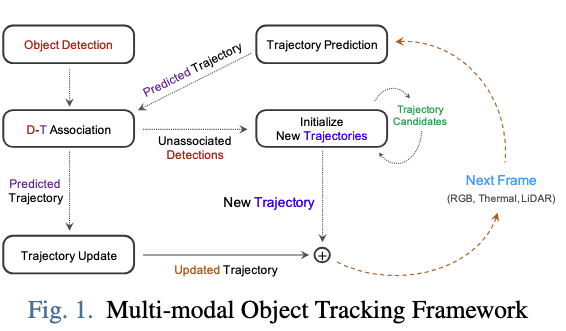
Multi-modal Object Detection, Tracking, and Action Classification for
Unmanned Outdoor Surveillance Robots
Kyuewang Lee*, Inseop Chung*, Daeho Um, Jaeseok Choi, Yeji Song, Seunghyeon Seo, Nojun Kwak, Jin Young Choi ICCAS, 2021.Oct We present a real-time multi-modal framework for outdoor robots that detects, tracks, and classifies human actions using RGB, thermal, and LiDAR data. |
|
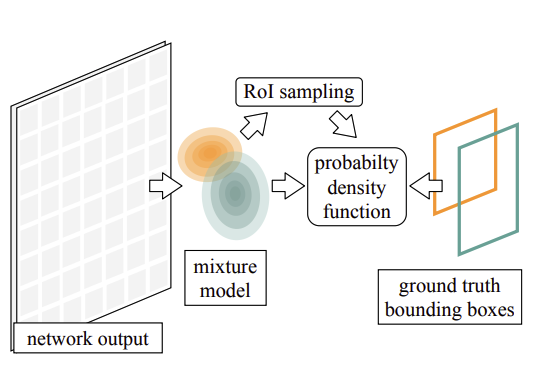
Training Multi-Object Detector by Estimating Bounding Box Distribution for
Input Image
Jaeyoung Yoo, Hojun Lee*, Inseop Chung*, Geonseok Seo, Nojun Kwak ICCV, 2021.Oct arXiv We propose MDOD, a novel object detector that formulates multi-object detection as bounding box density estimation using a mixture model, simplifying training and improving performance. |
|
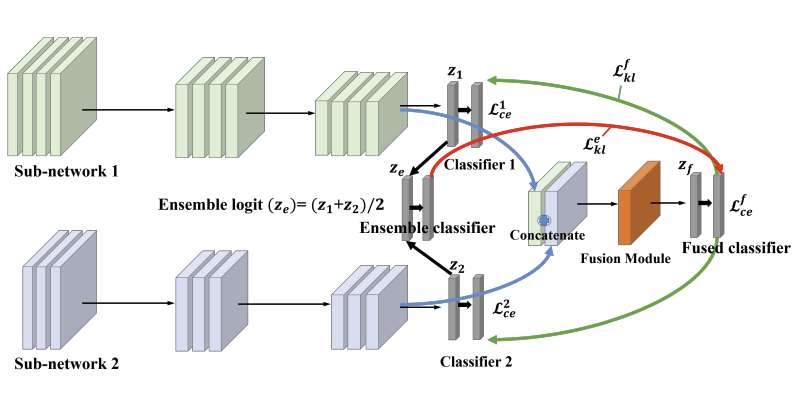
Feature Fusion for Online Mutual Knowledge Distillation
Jangho Kim, Minsugn Hyun, Inseop Chung, Nojun Kwak ICPR, 2021.Jan arXiv We propose Feature Fusion Learning (FFL), a mutual knowledge distillation framework that combines features from diverse sub-networks to train a stronger fused classifier, improving both overall and individual network performance. |
|
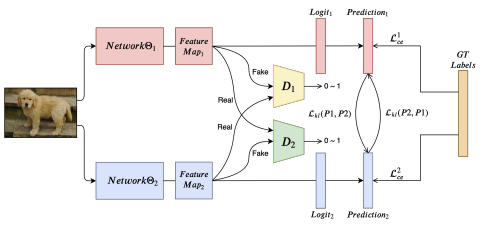
Feature-map-level Online Adversarial Knowledge Distillation
Inseop Chung, SeongUk Park, Jangho Kim, Nojun Kwak ICML, 2020.Jul Proceedings We propose an online knowledge distillation method that aligns feature maps via adversarial training, enabling networks to learn from each other's internal representations and improving performance, especially in mixed-size network setups. |
Education |
|

|
Ph.D. in Engineering, Seoul National University, 2019–2024 |

|
B.S. in Creative Technology Management & Computer Science, Yonsei University,
2012–2019 |
Work Experience |
|

|
Staff Researcher, Samsung Electronics, 2024.Mar–Present |

|
Research Intern, Qualcomm AI Research Korea, 2022.Jan–2022.Jul |

|
Research Intern, Naver Webtoons Corp., 2020.Jun–2020.Dec |
PatentsDomestic Patents
International Patents
|
Funding
|
Honour & Awards
|